
Wellness Habits for Families
Your children look to you to help set examples for how they should act and behave. If they see you making your health a priority—by eating nutritious foods, fitting in exercise, and protecting your mental health—they’re more likely to do so, too.
Instilling good habits in kids doesn’t have to be another parental chore. It can be a fun way to connect as a family. The payoff: Those wellness habits may stay with your child, increasing their chances of enjoying a long, active life.
With your guidance, your entire family can adopt lifestyle changes that help improve the overall health of each family member. Follow these 5 steps to get started.
5 steps for building good habits as a family
These actions can help your family make changes that benefit physical and mental health:
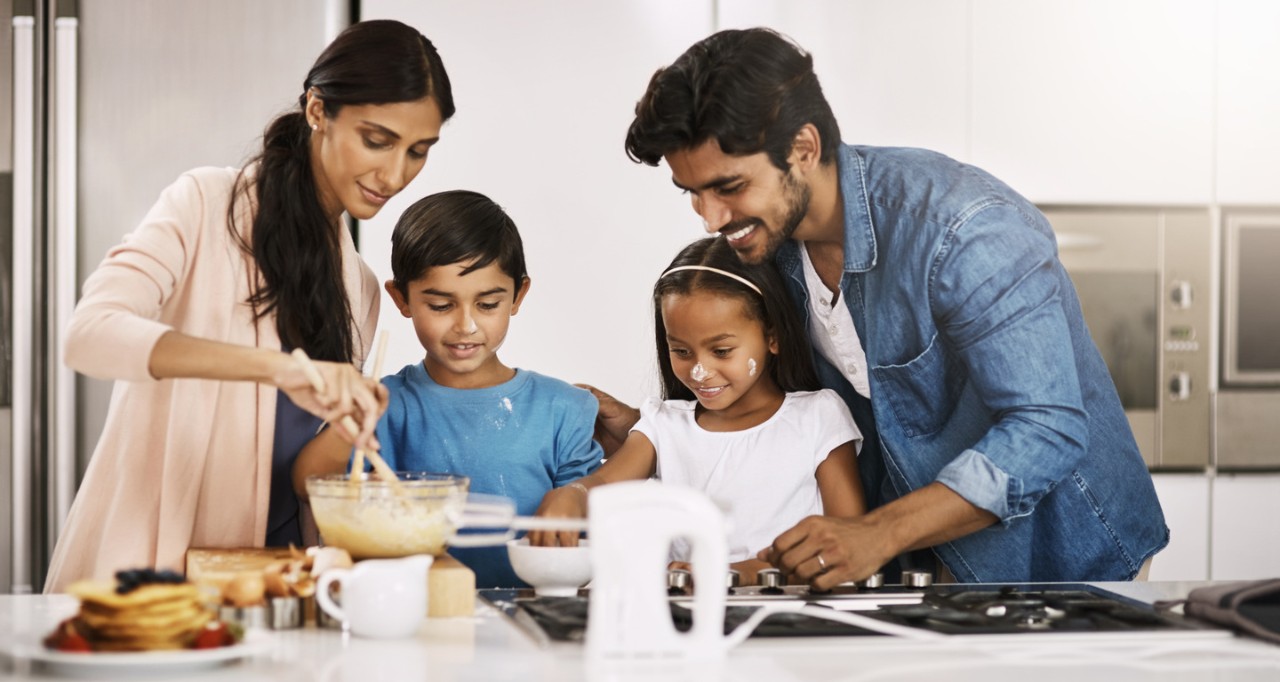
1. Let kids help with meals
Kids need a lot of vitamins and nutrients for their growing bodies. But they can also be picky about foods that are good for them, like vegetables. [i]
These steps can help expand your child’s tastes and ensure they eat nutritious foods:
· Take your child grocery shopping. Let them pick out a new-to-them veggie, fruit, or food they want to try.
· Look up recipes online with your child. Help them make a grocery list, shop for the items, and prepare the recipe.
· Ask your child to help cut up fresh fruits and vegetables. Buy child-friendly knives, then encourage them to help prepare snacks for the week.
· Grow some vegetables or herbs. You can grow them in a backyard or community garden, or in a few pots on the windowsill and use them in recipes.
· Eat family meals together whenever possible. Banish all electronics during meals, so you demonstrate the importance of being present and connecting with one another.
· Involve your child in post-meal cleanups. Encouraging their participation gets them into the habit of helping.
2. Be active as a family
An estimated 1 in 4 children don’t get 60 minutes of physical activity every day.[ii] That’s the minimal amount recommended by the American Academy of Pediatrics (AAP) and the Centers for Disease Control and Prevention (CDC).[iii] Physical activity is good for children and adults.[iv]
Some children enjoy organized sports like being on a soccer team. But you can also help make exercise a family affair by:[v]
· Going for a family walk or bike ride most nights after dinner.
· Taking your child to a public park to play on the playground or shoot hoops.
· Providing jump ropes, balls, pogo sticks, and other active toys.
3. Cut back on screen time
Kids today can spend 5 to 7 hours a day looking at a screen on a phone, computer, TV, or gaming console.[vi] That’s a lot of time sitting and staring. Too much screen time can negatively affect sleep and increase your child’s risk of anxiety, depression, and attention problems.[vii]
Reducing your child’s screen time may help them maintain a normal weight by freeing up more time for physical activity.[viii] It also limits their exposure to ads that can trigger a desire for junk [ix].[x]
Remember, your kids model their behaviors after you. Maybe you could do with a little less screen time, too? To cut back on screen time as a family:[xi]
· Remove screens during meals and homework.
· Keep TVs and computers out of bedrooms.
· Adopt screen-free family hobbies like puzzles, board games, reading, or going for a walk.
4. Help your child get more z’s
School-age children need 9 to 12 hours of sleep, while teens need a little less (8 to 10 hours of sleep).[xii] Sleep is important for a child’s physical growth and mental development.[xiii] Children and teens who are overly tired may struggle to think and learn. [xiv] Lack of sleep can affect a child’s mood, alertness, and ability to function.[xv] Unfortunately, an estimated 25% to 50% of children and 40% of teens don’t get the recommended amount of nightly slumber.[xvi]
Busy schedules, screen time, and poor sleep habits can affect your child’s ability to fall and stay asleep. These steps can help your child get the z’s they need:[xvii]
· Have a set bedtime and wake-up time, even on weekends. Be sure those times provide the recommended amount of sleep for your child’s age.
· Turn off all electronics at least 1 hour before bedtime.[xviii]
· Establish a relaxing wind-down routine, such as reading or listening to soothing music.
· Keep the bedroom dark, cool, and quiet.
· Use a white-noise machine to block outside sounds and distractions.
· Avoid large meals, caffeine, and sugary foods close to bedtime.
5. Find time to have fun and unwind
An estimated 8 million children and teens in the U.S. have depression or anxiety—and this number continues to rise.[xix] Kids are also dealing with a lot of stress from societal pressures, social media, mass violence, and other concerns.[xx]
It’s important to take time as a family to engage in relaxing and fun activities. Exercise, a nutritous diet, reduced screen time, and better slumber can help. You can also try these stress[xxi]busters:[xxii]
· Schedule outings: Make a list of places to explore in your community or activities you’d like to do together—and then schedule the time to make these things happen.
· Connect with loved ones: Spend time visiting grandparents, relatives, and friends who bring you joy, in person or via phone or video call.
· Practice gratitude: Create a jar to collect notes about what each family member is grateful for throughout the year. At the end of the year (or whenever someone needs a pick-me-up), read the notes together as a family.
In summary: Help your family get strong together
Changing behaviors and developing wellness habits takes time. To help your family get on board, you might start by setting small goals and focusing on a few smaller changes each month. Your children are more likely to be excited and engaged in these changes when you model that enthusiasm too. You won’t just be making wellness changes that can last a lifetime, you’ll be making great memories as a family, too.
Now that you know more about building good habits as a family, you may be curious about how the Sincerely Health tools in the BANNER app can help.
You can start by downloading the app. You’ll save $10 on groceries* for creating an account. Next, create a personalized Sincerely Health nutrition profile to receive 1,000 points*.
Your nutrition profile allows you to:
● Set specific nutrition goals.
● Earn 10 points for items you purchase for a maximum 100 points per order (that’s 10 items at 10 points each).*
FAQs about creating wellness family habits
How can you encourage healthier eating habits?
Let your child select a new food to try. Then, help them find an online recipe and participate in preparing the dish.[xxiii]
How does too much screen time affect a child’s health?
Too much screen time can negatively affect sleep and increase your child’s risk for anxiety, depression, and attention problems.[xxiv] Kids who look at screens all day also tend to be less active.[xxv]
What are some ways to get your sedentary child moving more?
Your entire family can be more physically active by walking, biking, or shooting hoops together .[xxvi]
Sign up for Sincerely Health and create a nutrition profile to help you level up today!
Sources
[i] American Heart Association. When Kids Help Cook, Family Meals Are Easier. Last reviewed September 11, 2024. https://www.heart.org/en/Wellness-living/Wellness-eating/cooking-skills/meal-planning/kids-help-cook#; Academy of Nutrition and Dietetics. Kids in the Garden: A Nutritious and Fun Experience. Last reviewed. https://www.eatright.org/food/planning/food-security-and-sustainability/kids-in-the-garden-nutritious-and-fun#; Nemours. Wellness Eating. Last reviewed June 2018. https://kidshealth.org/en/parents/habits.html; Mississippi State Department of Health. Wellness Habits for Wellness Kids. Last reviewed September 6, 2023. https://msdh.ms.gov/page/43,1698,213.html
[ii] American Academy of Pediatrics. 11 Ways to Encourage Your Child to Be Physically Active. Last reviewed December 30, 2020. https://www.Wellnesschildren.org/English/Wellness-living/fitness/Pages/Encouraging-Your-Child-to-be-Physically-Active.aspx; Centers for Disease Control and Prevention (CDC). Child Activity: An Overview. Last reviewed January 8, 2024. https://www.cdc.gov/physical-activity-basics/guidelines/children.html
[iii] American Academy of Pediatrics. 11 Ways to Encourage Your Child to Be Physically Active. Last reviewed December 30, 2020. https://www.Wellnesschildren.org/English/Wellness-living/fitness/Pages/Encouraging-Your-Child-to-be-Physically-Active.aspx; Centers for Disease Control and Prevention (CDC). Child Activity: An Overview. Last reviewed January 8, 2024. https://www.cdc.gov/physical-activity-basics/guidelines/children.html
[iv] Centers for Disease Control and Prevention (CDC). Child Activity: An Overview. Last reviewed January 8, 2024. https://www.cdc.gov/physical-activity-basics/guidelines/children.html; Centers for Disease Control and Prevention (CDC). Adding Physical Activity as an Adult. Last reviewed January 8, 2024. https://www.cdc.gov/physical-activity-basics/adding-adults/index.html
[v] American Academy of Pediatrics. 11 Ways to Encourage Your Child to Be Physically Active. Last reviewed December 30, 2020. https://www.Wellnesschildren.org/English/Wellness-living/fitness/Pages/Encouraging-Your-Child-to-be-Physically-Active.aspx; Centers for Disease Control and Prevention (CDC). Making Physical Activity Part of Your Child’s Life. Last reviewed August 7, 2024. https://www.cdc.gov/physical-activity-basics/adding-children-adolescents/index.html
[vi] MedlinePlus. Screen Time and Children. Last reviewed April 25, 2023. https://medlineplus.gov/ency/patientinstructions/000355.htm
[vii] MedlinePlus. Screen Time and Children. Last reviewed April 25, 2023. https://medlineplus.gov/ency/patientinstructions/000355.htm
[viii] Centers for Disease Control and Prevention. Tips to Support Wellness Routines for Children and Teens. Last reviewed December 20, 2024. https://www.cdc.gov/Wellness-weight-growth/tips-parents-caregivers/index.html; MedlinePlus. Screen Time and Children. Last reviewed April 25, 2023. https://medlineplus.gov/ency/patientinstructions/000355.htm
[x] Centers for Disease Control and Prevention. Tips to Support Wellness Routines for Children and Teens. Last reviewed December 20, 2024. https://www.cdc.gov/Wellness-weight-growth/tips-parents-caregivers/index.html
[xi] American Academy of Pediatrics. Beyond Screen Time: Help Your Kids Build Wellness Media Use Habits. Last reviewed July 20, 2022. https://www.Wellnesschildren.org/English/family-life/Media/Pages/Wellness-digital-media-use-habits-for-babies-toddlers-preschoolers.aspx; MedlinePlus. Screen Time and Children. Last reviewed April 25, 2023. https://medlineplus.gov/ency/patientinstructions/000355.htm
[xii] Centers for Disease Control and Prevention (CDC). About Sleep. Last reviewed May 15, 2024. https://www.cdc.gov/sleep/about/index.html#cdc_behavioral_basics_quick-getting-enough-sleep
[xiii] Sleep Foundation. Children and Sleep. Last reviewed November 8, 2023. https://www.sleepfoundation.org/children-and-sleep
[xiv] Sleep Foundation. Children and Sleep. Last reviewed November 8, 2023. https://www.sleepfoundation.org/children-and-sleep
[xv] Sleep Foundation. Children and Sleep. Last reviewed November 8, 2023. https://www.sleepfoundation.org/children-and-sleep
[xvi] Sleep Foundation. Children and Sleep. Last reviewed November 8, 2023. https://www.sleepfoundation.org/children-and-sleep
[xvii] Sleep Foundation. Children and Sleep. Last reviewed November 8, 2023. https://www.sleepfoundation.org/children-and-sleep; Sleep Foundation. How Blue Light Affects Kids’ Sleep. Last reviewed January 12, 2024. https://www.sleepfoundation.org/children-and-sleep/how-blue-light-affects-kids-sleep
[xviii] Sleep Foundation. How Blue Light Affects Kids’ Sleep. Last reviewed January 12, 2024. https://www.sleepfoundation.org/children-and-sleep/how-blue-light-affects-kids-sleep
[xix] Georgetown University Center for Children and Families. Research Update: Children’s Anxiety and Depression on the Rise. Last reviewed March 24, 2022. https://ccf.georgetown.edu/2022/03/24/research-update-childrens-anxiety-and-depression-on-the-rise/
[xx] American Psychological Association. Kids’ mental health is in crisis. Here’s what psychologists are doing to help. Last reviewed January 1, 2023. https://www.apa.org/monitor/2023/01/trends-improving-youth-mental-health
[xxii] Mayo Clinic. Wellness Habits for Families. Last reviewed February 4, 2021. https://www.mayoclinichealthsystem.org/hometown-health/speaking-of-health/12-Wellness-habits-for-families
[xxiii] Nemours. Wellness Eating. Last reviewed June 2018. https://kidshealth.org/en/parents/habits.html; American Heart Association. When Kids Help Cook, Family Meals Are Easier. Last reviewed September 11, 2024. https://www.heart.org/en/Wellness-living/Wellness-eating/cooking-skills/meal-planning/kids-help-cook#; Academy of Nutrition and Dietetics. Kids in the Garden: A Nutritious and Fun Experience. Last reviewed. https://www.eatright.org/food/planning/food-security-and-sustainability/kids-in-the-garden-nutritious-and-fun#; Mississippi State Department of Health. Wellness Habits for Wellness Kids. Last reviewed September 6, 2023. https://msdh.ms.gov/page/43,1698,213.html
[xxiv] MedlinePlus. Screen Time and Children. Last reviewed April 25, 2023. https://medlineplus.gov/ency/patientinstructions/000355.htm;
[xxv] MedlinePlus. Screen Time and Children. Last reviewed April 25, 2023. https://medlineplus.gov/ency/patientinstructions/000355.htm
[xxvi] American Academy of Pediatrics. 11 Ways to Encourage Your Child to Be Physically Active. Last reviewed December 30, 2020. https://www.Wellnesschildren.org/English/Wellness-living/fitness/Pages/Encouraging-Your-Child-to-be-Physically-Active.aspx; Centers for Disease Control and Prevention (CDC). Making Physical Activity Part of Your Child’s Life. Last reviewed August 7, 2024. https://www.cdc.gov/physical-activity-basics/adding-children-adolescents/index.html